Explore Collections Explore The Collections
You are here: CollectionsOnline  /  Drawings

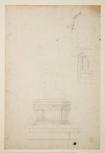
London: St Mary Abbots burial ground, Church Street, Kensington: tomb for Miss Elizabeth Johnston for 1st Earl of Bellamont, July 1784 (5)

1784
'Sarcophagus' (the term used by Soane) describes a stone coffin or tomb chest of a Classical type. The source for the design was usefully revealed by Soane when he wrote 'Cecilia Metella' on drawing 1 (SM 63/6/20). Her tomb on the Via Appia housed a sarcophagus that was removed to the Cortile of the Palazzo Farnese, Rome, where it remains. This sarcophagus was the source for Soane's preliminary design, the proportions and curved fluting are similar and the mouldings and carved decoration of the lid were adapted by Soane. The executed design, seen first in drawing 2 (SM volume 12/15), is simpler than the earlier design but retains the 'bath tub' form and strigilated decoration though now in the form of a band.

The large lugged label on the north face (there is another on the other side) does not appear on Cecilia Metella's sarcophagus but was needed for the long inscription to Miss Johnston which reads 'IN MEMORY / Of the Amiable and beloved eldest Daughter / Of the late Mr ROBERT JOHNSTON of Brompton Gentleman / MISS ELIZABETH JOHNSTON / who / Having laid an humble Monument of / Filial piety to parental merit and affection / EXPIRED / On the third day of May One thousand Seventeen hundred and / Eighty four. In the twenty third year of her age. / Her gentle Pride and Tenderness / Her Constancy and Truth / Leaving Tears and bitterness of heart / The Earthly portion of her / Disconsolate Friends'. This epitaph was presumably composed by Charles Coot, Earl of Bellamont (1738- 1800) who commissioned the tomb. He was a notorious womaniser known as the 'Hibernian Seducer' who is said to have bigamously married Miss Johnston, their son being born in 1781 or 1782.

Listed Grade 2 in 1990, the tomb was restored by the Soane Monuments Trust in 1992 when it was discovered that the tomb was empty and that there was no 'catacomb' below. The explanation, it is assumed, was that the tomb was moved to its present site in the north-west part of the graveyard when the church was rebuilt by Sir George Gilbert Scott in 1868-72.

A vignette of the tomb appears in J.M.Gandy's large perspective of Soane's Designs for public and private buildings , 1828.

Soane's Day Book for 1784 has an entry for 20 July: 'Lord Bellamont, 3 fair drawings / 3 working drawings / Description & Estimate & Attendance - 10.10.0'. Bills from 21 August to 11 September 1784, record a total expense to the Earl of £234.1.8 including Soane's fee of £21.0.0. Christopher Woodward (TS catalogue entry, SM green box files) points out that 'Soane is first recorded as meeting Lord Bellamont on Sunday 18 July 1784. Already that month, Soane had given time to at least 14 projects "in hand" but, without an assistant, he devoted three uninterrupted days to this commission.'

Jill Lever, July 2009
Architectural & Other Drawings results view
Select list view result
Select thumbnail view result
Architectural & Other Drawings results view
Select list view result
Select thumbnail view result